America Jones was born the day the burning building, the burning bush. Was first the crow to cross the birth, broke the window flat on floor, maggots turned from splintered break. Was thus she raised the son with pious fury. Utterly alone. America a war red white and blue stripe and star, alone an island ocean. Alone her savage want of suckle at her breast. With want to taste her honey. Beyond the water ocean darkness demons fell to madness in the winter silence nordic forests all was still. Was then with song the seed was laid and grow. Them seed as water taint the sky, falling ash. Her sing the hymn of forests. Have winter here is darkness.
Soft! What possible music, my dear sweet lady, could scarce then deign to consecrate the carnal rectangle of your nubile eyelash, to whisper amber sweetness, in gardens of flowerly bliss...
there are trapezoids such, octagons, and newsprint... when the device is activated with radio waves, it emits a quick burst of identifying data. this is how we keep track of you. very soon, somebody will turn you in.
you can drown in emanations, saintly prefix exclusion, the arabesque radiocafe...
analytical devices analog maneuver, i do not travel by auto. always then happens always most often, eternity never repeats. yet still this strange, uncomfortable titular consolation, that perhaps it is not God who judges, but rather it is God who is judged. This is a sickness to heal the heart like starvation, a cathedral then, home to beggars pimps and priests all the blessed poor in spirit, a sickness of the heart the automobile daily rapes her ovaries to suckle the genitals of banking institutions, and lives taken in occupation...
A betrothal in chains to this tender war machine, a life to struggle with wakefulness or sleep, fear or love of marriage for a martyr’s death... i do not think it well to hope for recovery from this sickness, as lust is but a cruelty of imagination, such is the danger in truth (the open grave of faith), a stale dew upon the corpses of whole civilizations gone mad...
What whispers tell of what remains, what should yield the hunger of these savage thoughts, this animal need... i do not think it well to hope for recovery from this illness... nor needn’t watch the moon as swallowed by the pregnant ouroboros vagrant escapades, nor the tangled bowels of the living machinery torn from the bleeding wall...
And broken glass, so beautifully abused... nor need to hear these screams through night, sickly hallucinations above the rooftops, and radiate disease in luminous night... for buildings to dream the cathode rays fluorescent, beneath the unanimous horizon...
Showing posts with label dada. Show all posts
Showing posts with label dada. Show all posts
Wednesday, January 24, 2007


Wednesday, April 19, 2006
logically consistent poetry
“The Painted Word” is a satirical essay by Tom Wolf that considers the consequences of how, in contemporary art, artists often produce works of art in order to illustrate particular critical statements.
Tom Wolf’s notion of the painted word finds corollaries in the writings of such aestheticians as Arthur Danto and George Dickie. Arthur Danto has discussed at length how, in contemporary art, it is no longer possible to determine if a given object is art or not based solely on appeal to the formal properties of that object (a common illustration of this point is Marcel Duchamp’s Fountain). In “Art, Philosophy, and the Philosophy of Art,” Danto uses Andy Warhol’s “Brillo Box” as a case study in the importance of theory in contemporary art (a demonstration of the total equivocality of art objects). Danto wonders:
"why were his boxes works of art while the almost indistinguishable utilitarian cartons were merely containers for soap pads? Certainly the minor observable differences could not ground as grand a distinction as that between Art and Reality!"
George Dickie, in his essay “Art and the Aesthetic: An Institutional Analysis” offers as a reply that an object may qualify as art if it is recognized by intellectual art institutions as art; the way in which a given object garners the status of art object is often by appeal to critical justification.
Like many trends in contemporary art, the painted word was prefigured by various figures in the Dada movement. The justification for the aesthetic concerns of, for example, Hugo Ball, Marcel Duchamp, and Max Ernst, was an implicit ideology that required an explicit articulation given the art-historical context and the expectations of the art-going public of the time. Although for a lack of political convictions Kurt Schwitters was not permitted to officially join the Dada, the work of Kurt Schwitters demonstrates a virtuosic array of aesthetic and technical concerns. Schwitters indulged in the realms of surrealist and opto-phonetic poetry, expressionist painting, collage, and assemblage. Through association with such prominent artists as Theo Van Doesburg, who was connected to both De Stijl and the Bauhaus, Schwitters demonstrated a highly refined sense of geometric formalism; Schwitters also produced work bearing a strong resemblance to the neoplasticism of Piet Mondrian.
[REDACTED]
is the critical statement Schwitters printed in the periodical “G,” No. 3, 1924, Schwitters included a treatise on the subject of “Logically Consistent Poetry.” A structural linguistic analysis, Schwitters’s statement on logically consistent poetry assumes that “it is impossible to explain the meaning of art,” and in his construction of a critical reductio-ad-absurdum proceeds to postulate that “the basic material of poetry is not the word but the letter.” To quote Schwitters:
1. The sequence of letters in a word is unequivocal, the same for everyone. It is independent of the personal attitude of the beholder.
2. Sound is only unequivocal in the spoken word. In the written word, the sound depends on the capacity of the beholder to imagine it. Therefore sound can only be material of the reciting of poetry and not for the writing of poetry.
3. Meaning is only unequivocal when, for example, the object signified by the word is actually present. Otherwise it is dependant on the imaginative capacity of the beholder.
4. The association of ideas cannot be unequivocal because it is dependent solely on the associative capacity of the beholder. Everyone has different experiences and remembers and associates them differently.
Schwitters concludes that “a logically consistent poem evaluates letters and groups of letters against eachother.” To this end, he composed his “Ursonate,” which clocks in at about 45 minutes when recited, and requires an elaborate system of graphic notations to indicate what sounds correspond to which symbols on the printed page.
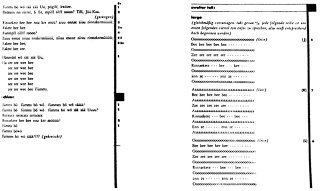
Although Schwitters ultimately demonstrated the compatibility of critical insight with aesthetic beauty, he also demonstrated the limitations of critical methodology by using his art to illustrate the way in which critical elucidation often leads to satirical consequences or blatant absurdity. In composing his “Ursonate,” which is linguistic gibberish, Schwitters was able to make an extremely articulate statement about art and criticism in conjunction with his writings on methodology.
While it is possible to illustrate the subtlety and complexity of Schwitters in the context of a deconstructive analysis of the dissolution of the boundaries between
[REDACTED]
while a work of art may seem meaningless or pointless, for better or for worse, it can (and often is) related to a very specific subjectmatter in a very specific way that is mediated by critical methodology.
[REDACTED]
Tom Wolf’s notion of the painted word finds corollaries in the writings of such aestheticians as Arthur Danto and George Dickie. Arthur Danto has discussed at length how, in contemporary art, it is no longer possible to determine if a given object is art or not based solely on appeal to the formal properties of that object (a common illustration of this point is Marcel Duchamp’s Fountain). In “Art, Philosophy, and the Philosophy of Art,” Danto uses Andy Warhol’s “Brillo Box” as a case study in the importance of theory in contemporary art (a demonstration of the total equivocality of art objects). Danto wonders:
"why were his boxes works of art while the almost indistinguishable utilitarian cartons were merely containers for soap pads? Certainly the minor observable differences could not ground as grand a distinction as that between Art and Reality!"
George Dickie, in his essay “Art and the Aesthetic: An Institutional Analysis” offers as a reply that an object may qualify as art if it is recognized by intellectual art institutions as art; the way in which a given object garners the status of art object is often by appeal to critical justification.
Like many trends in contemporary art, the painted word was prefigured by various figures in the Dada movement. The justification for the aesthetic concerns of, for example, Hugo Ball, Marcel Duchamp, and Max Ernst, was an implicit ideology that required an explicit articulation given the art-historical context and the expectations of the art-going public of the time. Although for a lack of political convictions Kurt Schwitters was not permitted to officially join the Dada, the work of Kurt Schwitters demonstrates a virtuosic array of aesthetic and technical concerns. Schwitters indulged in the realms of surrealist and opto-phonetic poetry, expressionist painting, collage, and assemblage. Through association with such prominent artists as Theo Van Doesburg, who was connected to both De Stijl and the Bauhaus, Schwitters demonstrated a highly refined sense of geometric formalism; Schwitters also produced work bearing a strong resemblance to the neoplasticism of Piet Mondrian.
[REDACTED]
is the critical statement Schwitters printed in the periodical “G,” No. 3, 1924, Schwitters included a treatise on the subject of “Logically Consistent Poetry.” A structural linguistic analysis, Schwitters’s statement on logically consistent poetry assumes that “it is impossible to explain the meaning of art,” and in his construction of a critical reductio-ad-absurdum proceeds to postulate that “the basic material of poetry is not the word but the letter.” To quote Schwitters:
1. The sequence of letters in a word is unequivocal, the same for everyone. It is independent of the personal attitude of the beholder.
2. Sound is only unequivocal in the spoken word. In the written word, the sound depends on the capacity of the beholder to imagine it. Therefore sound can only be material of the reciting of poetry and not for the writing of poetry.
3. Meaning is only unequivocal when, for example, the object signified by the word is actually present. Otherwise it is dependant on the imaginative capacity of the beholder.
4. The association of ideas cannot be unequivocal because it is dependent solely on the associative capacity of the beholder. Everyone has different experiences and remembers and associates them differently.
Schwitters concludes that “a logically consistent poem evaluates letters and groups of letters against eachother.” To this end, he composed his “Ursonate,” which clocks in at about 45 minutes when recited, and requires an elaborate system of graphic notations to indicate what sounds correspond to which symbols on the printed page.
Although Schwitters ultimately demonstrated the compatibility of critical insight with aesthetic beauty, he also demonstrated the limitations of critical methodology by using his art to illustrate the way in which critical elucidation often leads to satirical consequences or blatant absurdity. In composing his “Ursonate,” which is linguistic gibberish, Schwitters was able to make an extremely articulate statement about art and criticism in conjunction with his writings on methodology.
While it is possible to illustrate the subtlety and complexity of Schwitters in the context of a deconstructive analysis of the dissolution of the boundaries between
[REDACTED]
while a work of art may seem meaningless or pointless, for better or for worse, it can (and often is) related to a very specific subjectmatter in a very specific way that is mediated by critical methodology.
[REDACTED]
Subscribe to:
Posts (Atom)

